Workspace and reach
Reach
The furthest the flange centre gets from the axis of joint 1, within the joint limits: 408 mm. The standard pneumatic gripper's tool centre point gets to 434 mm. A longer tool reaches further and weighs on joints 4 and 5.
Workspace
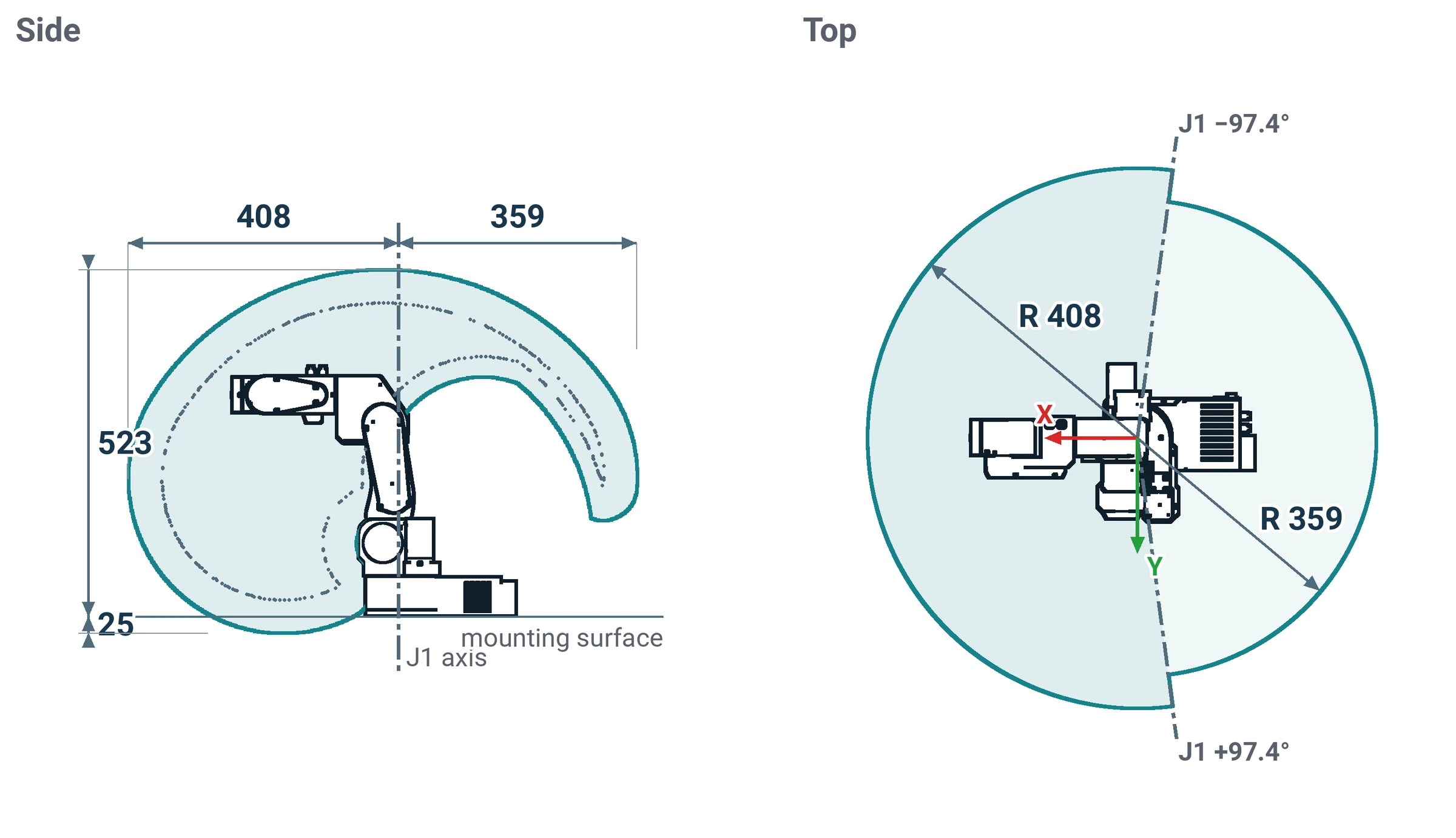
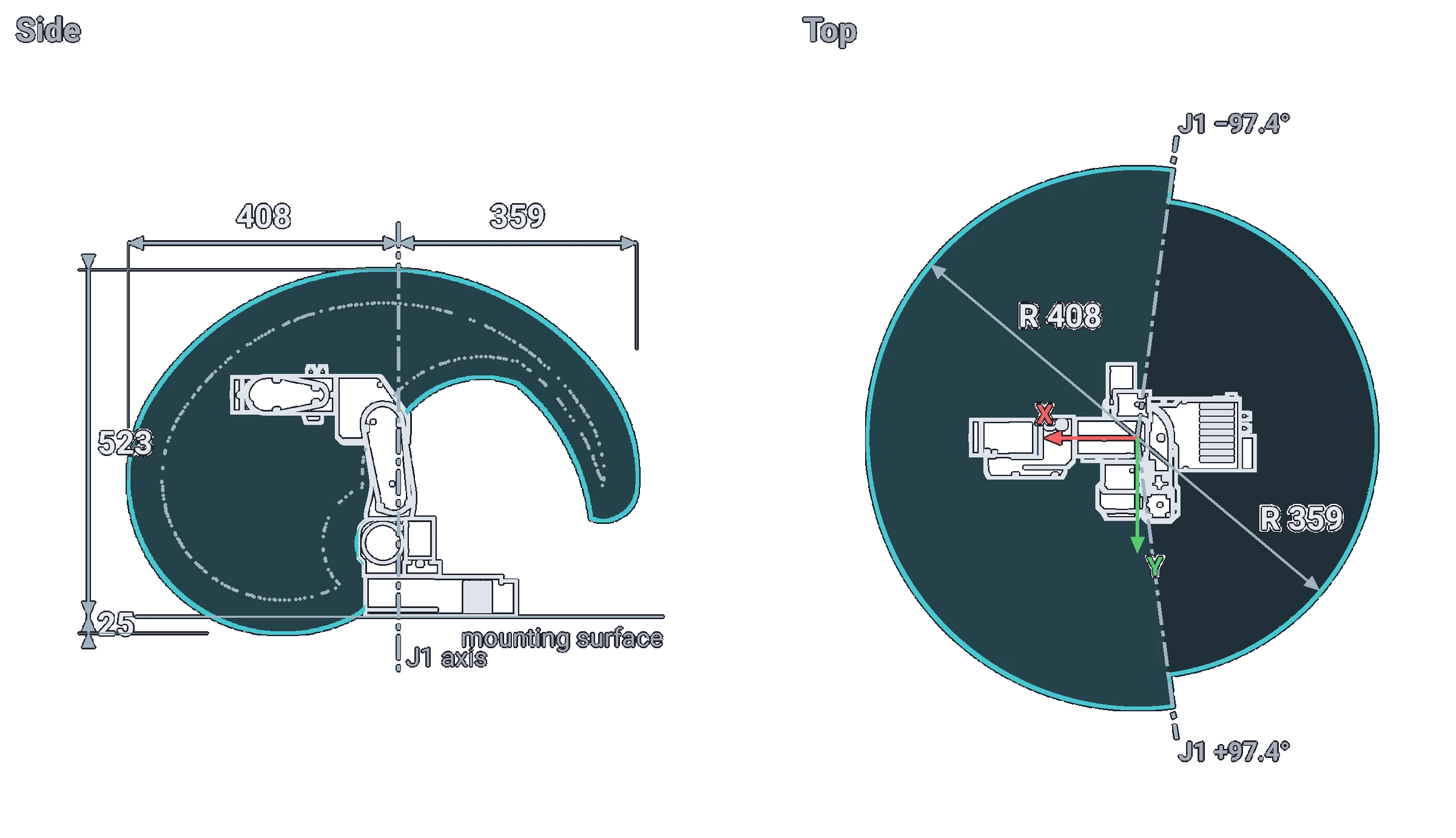
In the side view the shaded region is everywhere the centre of the flange can go in the plane of the arm, within the joint limits of the robot's model; the dotted line is the same for the wrist centre. It reaches 408 mm in front of the joint 1 axis and 359 mm behind it, 523 mm above the mounting surface and 25 mm below it. The top view sweeps that region about joint 1 through its ±97.4°: in front of the base the arm reaches out directly, behind it (lighter) only by folding back over the base. A tool adds its own length; the same figure for each gripper, with a table of the numbers, is on Dimensions and kinematics. The region is computed from the limits only: the arm's own parts, the tool and the table can block some of it.
The volume the tool can reach. The reachable workspace is every point it can touch with some orientation: a near-sphere of the reach, minus the base, minus the volume behind the elbow that the limits of joints 2 and 3 exclude. The dexterous workspace is the part of it where the tool can take any orientation, much smaller, around the middle of the reach and in front of the robot. A program that needs a particular orientation at a point needs that point in the dexterous workspace, and the way to find out is to jog there and try.
Payload across the workspace
1 kg close to the base, 0.5 kg at full reach: the torque on joints 2 and 3 grows with the distance, and the steppers' torque does not. A heavy tool shrinks the workspace in which the arm moves without losing steps.
Placing the task
Faster cycles and a larger usable workspace come from the layout, not from the program: put the work in front of
the robot at mid reach, at a height that keeps the elbow bent, and away from the joint 1 axis. Move the robot or
the fixture rather than fighting the kinematics. The Python API's reachable() reports how much travel each joint
and axis has left from the current pose, which tells you how close to a limit the program works.
Comments
Found a mistake on this page? Edit it on GitHub · Report it · Get help · This page as Markdown · llms.txt · The whole manual as PDF