Currents and temperatures
Motor currents
The control board sets each motor's running current in the firmware. The values are chosen for the motors of the BOM and for the printed parts around them; joints 4 and 5 run below their motors' rating because their motors are enclosed in the forearm.
| Joint | Maximum current (constants.h) |
Current while moving | Holding current |
|---|---|---|---|
| Joint 1 | 2000 mA | 85 % of the maximum: 1700 mA | 70 % of that: 1190 mA |
| Joint 2 | 2000 mA | 1700 mA | 80 %: 1360 mA |
| Joint 3 | 1900 mA | 1615 mA | 80 %: 1292 mA |
| Joint 4 | 1700 mA | 1445 mA | 80 %: 1156 mA |
| Joint 5 | 1700 mA | 1445 mA | 80 %: 1156 mA |
| Joint 6 | 965 mA | 820 mA | 88 %: 722 mA |
The firmware calls rms_current(MOTORx_MAX_CURRENT * 0.85, hold_multiplier); the hold multiplier is 0.7 for
joint 1, 0.8 for joints 2 to 5 and 0.88 for joint 6 (motor_init.cpp; Firmware parameters). Lower currents give
less torque, which means lower reachable speeds and accelerations and a higher chance of lost steps; higher
currents heat the motors and the plastic around them.
Temperatures
Stepper motors are rated for 100 °C and more, but PAROL6 is plastic, and PETG softens around 80 °C. These are the motor case temperatures measured on a robot at the default currents, at room temperature:
| Joint | Holding position for 5 h | Moving for 2 h |
|---|---|---|
| Joint 1 | 51 °C | 64 °C |
| Joint 2 | 54 °C | 64 °C |
| Joint 3 | 48 °C | 52 °C |
| Joint 4 | 60 °C | 73 °C |
| Joint 5 | 60 °C | 72 °C |
| Joint 6 | 61 °C | 65 °C |
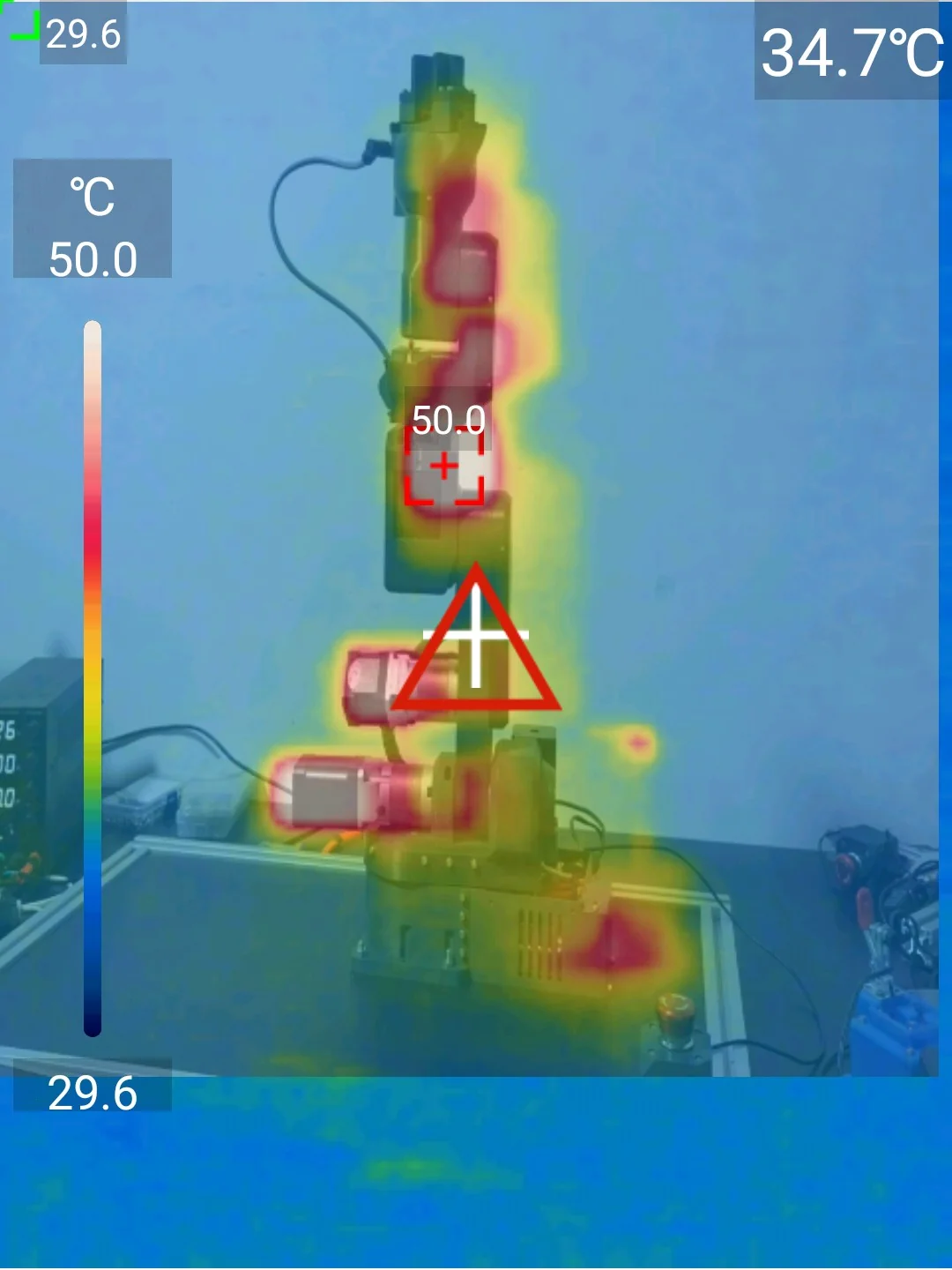
Through a thermal camera, a powered PAROL6 shows where the heat is: the motors of joints 2 and 3 beside the shoulder, the elbow (the hottest point in this picture, 50 °C) and the wrist motors in the forearm, and the control board at the back of the base. The scale runs from 29.6 to 50.0 °C.
Long runs
Joints 4 and 5 come within 10 °C of the plastic's limit after two hours of continuous motion. For a robot that
runs for hours, reduce the currents in the firmware (MOTORx_MAX_CURRENT in constants.h, or the
hold_multiplier in motor_init.cpp), lower the duty cycle, or let it rest in a pose that does not load the
motors. A deformed forearm cannot be straightened: it has to be printed again.
The stepper drivers protect themselves: a TMC5160 that gets too hot shuts its outputs down, and its joint goes limp. The fan in the base keeps them well below that (Control board technical data). Firmware 1 does not tell the PC when a driver is hot: the joints' temperature error bits in its packet are always 0. The driver temperature is not the motor temperature.
Comments
Found a mistake on this page? Edit it on GitHub · Report it · Get help · This page as Markdown · llms.txt · The whole manual as PDF