Pneumatics
Two 4 mm tubes run inside the arm from the push-in fittings at the base to the forearm, where the pneumatic or vacuum gripper connects. A 5/2 solenoid valve at the base, driven by an output, switches the air.
Pressure
5 to 7 bar; check your gripper's rating, and stay below the lowest rating of the gripper, the valve and the fittings. The tubes and fittings are standard 4 mm pneumatic parts.
The valve
A 5/2 valve, 24 V coil, 4 mm ports: one port from the compressor, two to the base fittings, the exhausts open. The coil goes between GND_SEL and OUTPUT1 (Inputs and outputs). Which of the two outputs is pressurised when the coil is off decides whether the gripper is normally open or normally closed: swap the two tubes to change it.
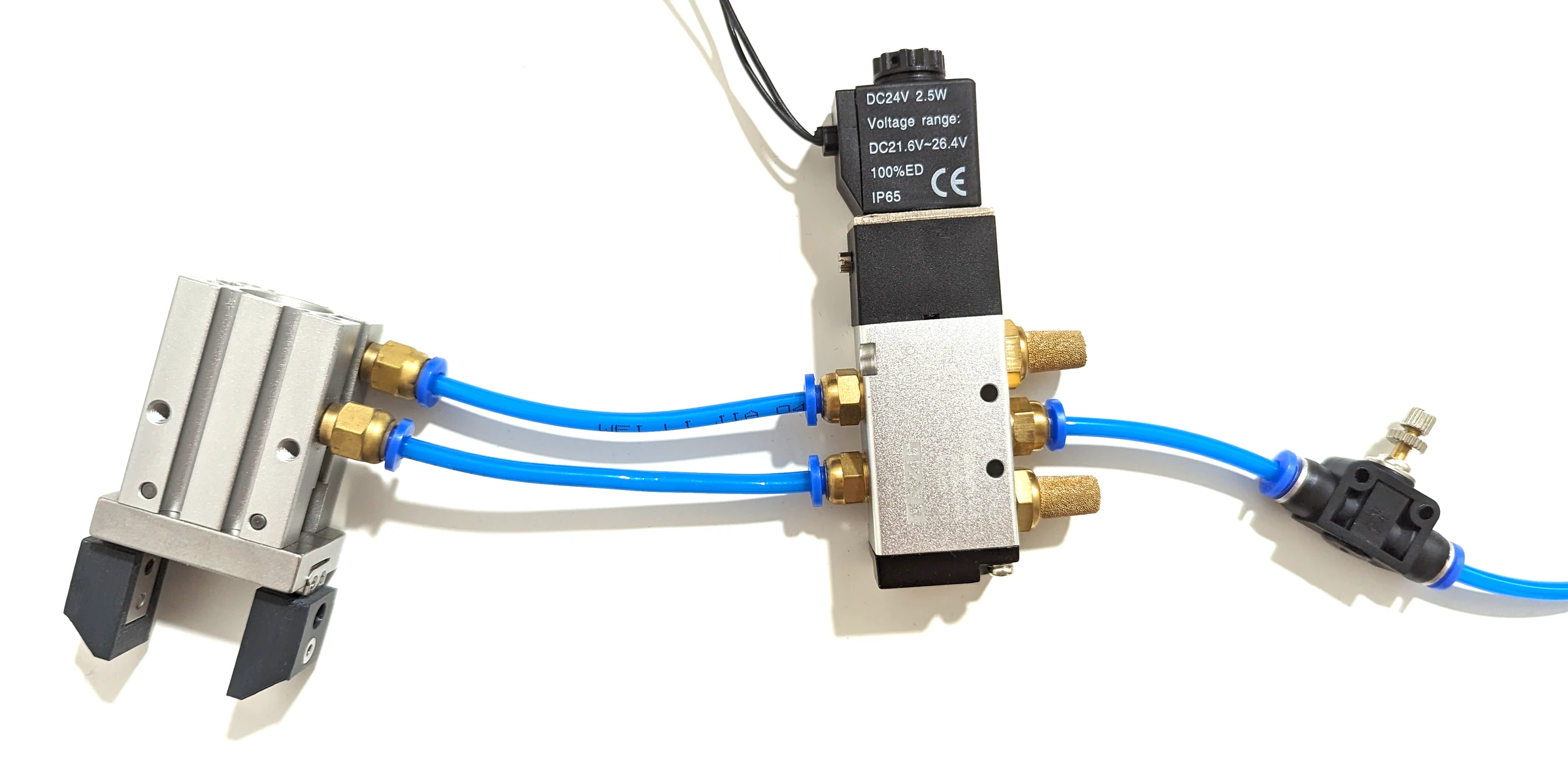
Routing
The arm's tubes run inside it from the base to the push-in fittings on the forearm; they are one reason for the one-turn rule of the joints. From the forearm fittings, the gripper's own tubes cross joints 5 and 6 outside the arm, like an electric gripper's cable: give them enough slack for the range you use, since they, not the flange, limit joint 6. Outside the base, give the tubes a loop so the arm cannot pull them.
A vacuum gripper
Needs one line only: block the valve's second port (Vacuum gripper).
In the Python API, a pneumatic or vacuum tool's open() switches output 1 high and close() switches it low,
whatever the tubing does: lay the tubes so the two match (Pneumatic gripper).
Comments
Found a mistake on this page? Edit it on GitHub · Report it · Get help · This page as Markdown · llms.txt · The whole manual as PDF