Printing the parts
Material
PETG. The motors run warm and the parts around them see 60 to 70 °C in long use, which PLA does not survive; PETG softens around 80 °C, prints without an enclosure, and bonds layers well. ABS or ASA work with an enclosure. The repository's PETG notes give the printing basics: hot end 220 to 250 °C, bed 60 to 90 °C with glue, a layer fan, and the warping is small.
The files
All parts are in the repository's STL folder, grouped by link:
BASE, SHOULDER, UPPER_ARM, ELBOW, FOREARM, WRIST, ESTOP, GRIPPER_ATTACHMENTS, UTILITY, mounting plates,
and SMALL_PRINT_BED for the split versions of the two largest parts.
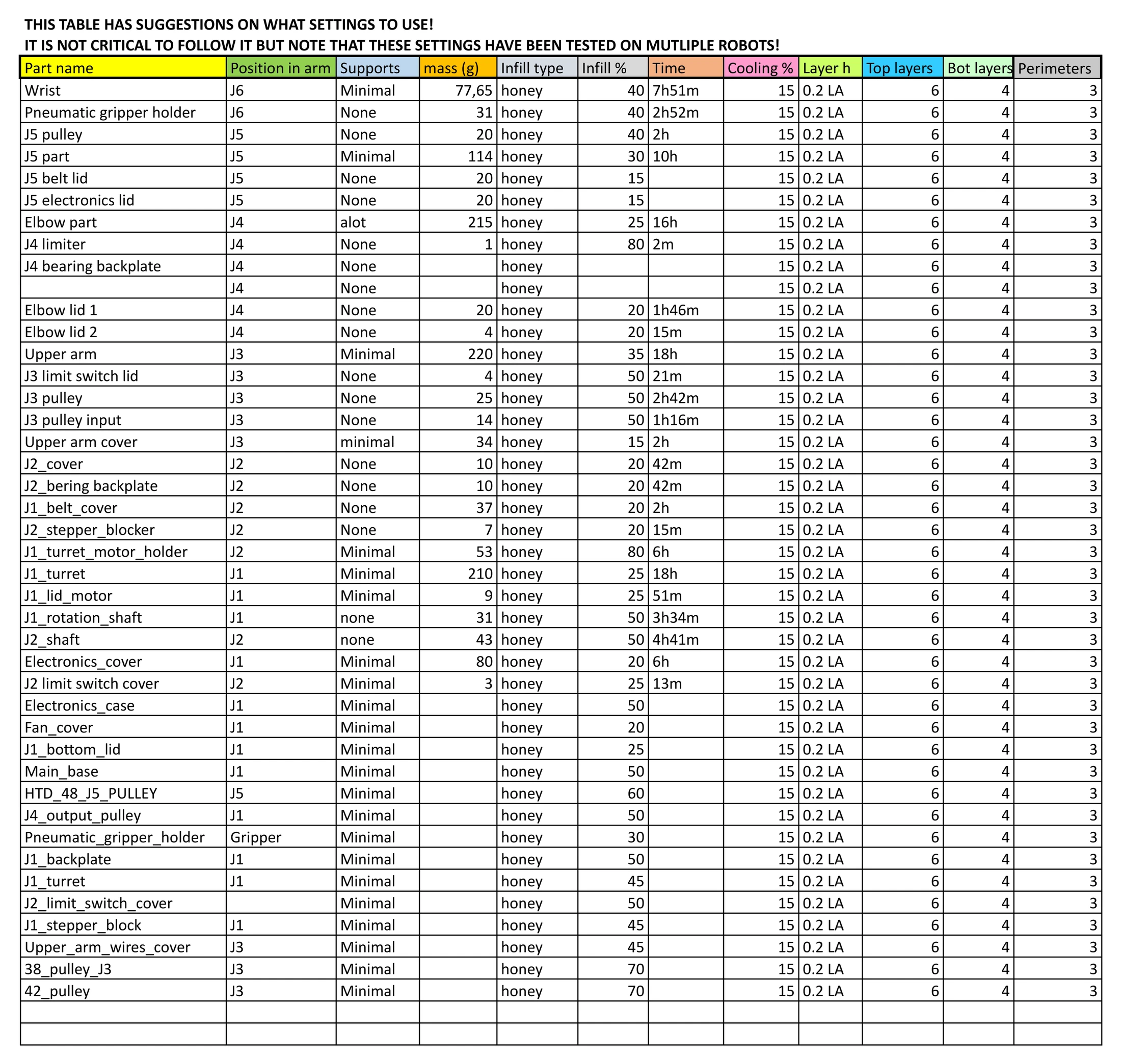
The print table below says how each was printed on the reference robots; it is a tested starting point, not a
rule.
Print table
The print table from the robot's repository, as it is. Every printed part with the settings it was printed with on the reference robots: supports, mass, infill, print time, cooling, layer height, top and bottom layers, perimeters. Click the table to enlarge it. The same table is in the repository as a PDF and as an Excel file.
Print the pulleys with high infill and slow outer walls: their teeth carry the load. Check the first printed pulley against a belt before printing the rest.
Tolerances
Bearing seats and shafts are designed for a well-calibrated printer; a seat that is too tight is reamed, one that is too loose is shimmed with tape or a drop of epoxy. Test the fit of the tapered bearings in their seats before assembling a joint.
Inserts
Four M3 brass inserts are melted into their holes with a soldering iron; everything else screws directly into the plastic.
Comments
Found a mistake on this page? Edit it on GitHub · Report it · Get help · This page as Markdown · llms.txt · The whole manual as PDF