SSG-48 adaptive electric gripper
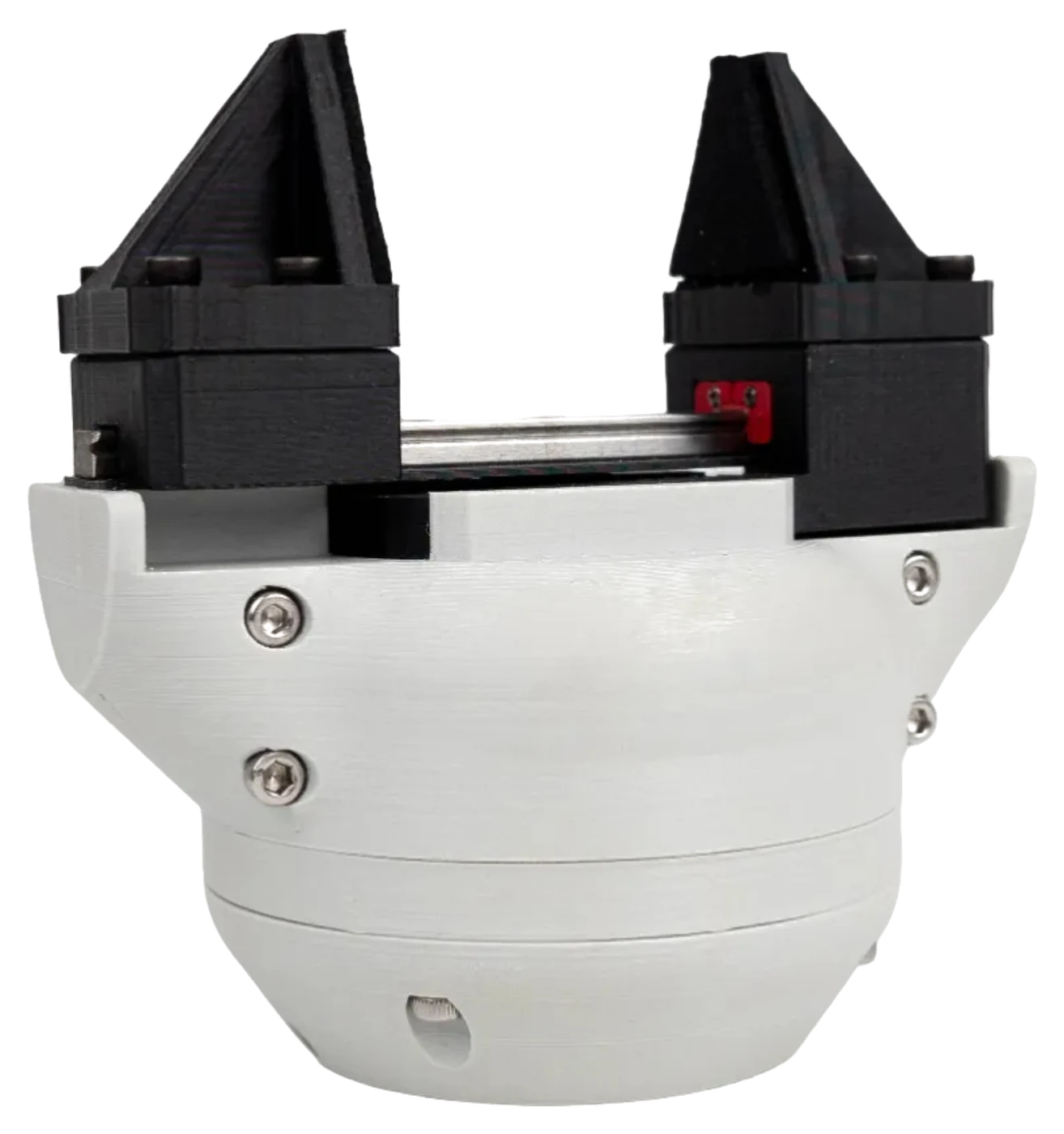
Source Robotics' 48 mm electric gripper: a Spectral Micro BLDC driver in gripper mode. It plugs into the M8 connector at the forearm and the control board drives it over CAN; the commander software and the Python API both know it. Its own manual, SSG48-gripper-docs, covers the gripper; this page covers PAROL6.
| Stroke | 48 mm |
| Grip force | about 54 N per ampere, 5 to 80 N; on PAROL6 up to about 54 N from the commander, 70 N from the Python API |
| Fingers | fin-ray or pinch, printed: finger and pinch in the Python API |
| Shop | SSG-48 |
Mounting
- Fit
coupler_connector_PAROL6from the gripper's repository to the gripper. It carries a shaft coupler with an 8 mm bore and two M4 clamp screws for the joint 6 shaft, and the homing tab that joint 5 homes against: the tab goes on the same side as the gripper's cable connector, with an M3 × 12 screw in the marked hole, as the gripper's assembly manual shows on its last pages. - Slide the gripper onto the joint 6 shaft, orient it, and tighten the two clamp screws, one on each side, with blue threadlocker (Couplers and threadlocker).
- Connect the PAROL6 gripper cable between the gripper and the M8 connector at the forearm.
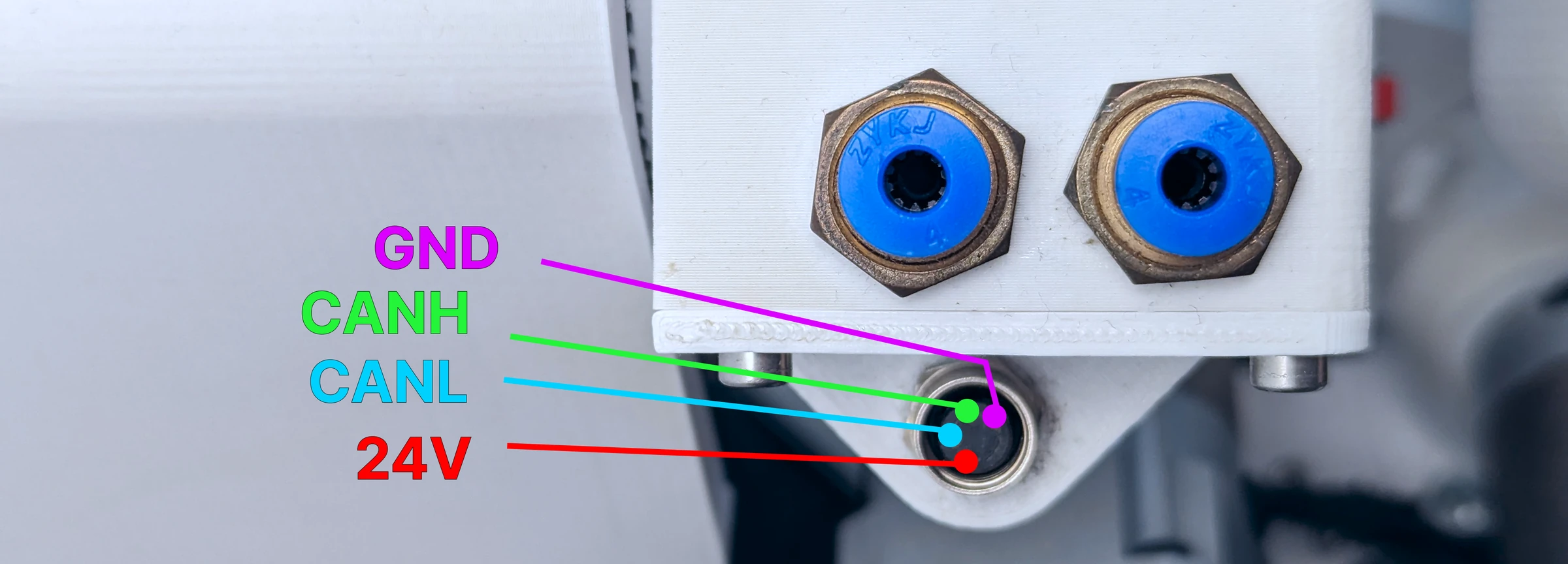
Only the PAROL6 cable
PAROL6 and PAR6 put the four signals on different pins. The PAR6 cable, or a self-made cable with a wrong pin, puts 24 V on the CAN pins and destroys the gripper's driver. The gripper manual's cable page has the pinout to check your own against.
Leave the gripper's CAN node ID at 0 and its termination switch on: it is the last node on the robot's bus (CAN bus).
Tool centre point
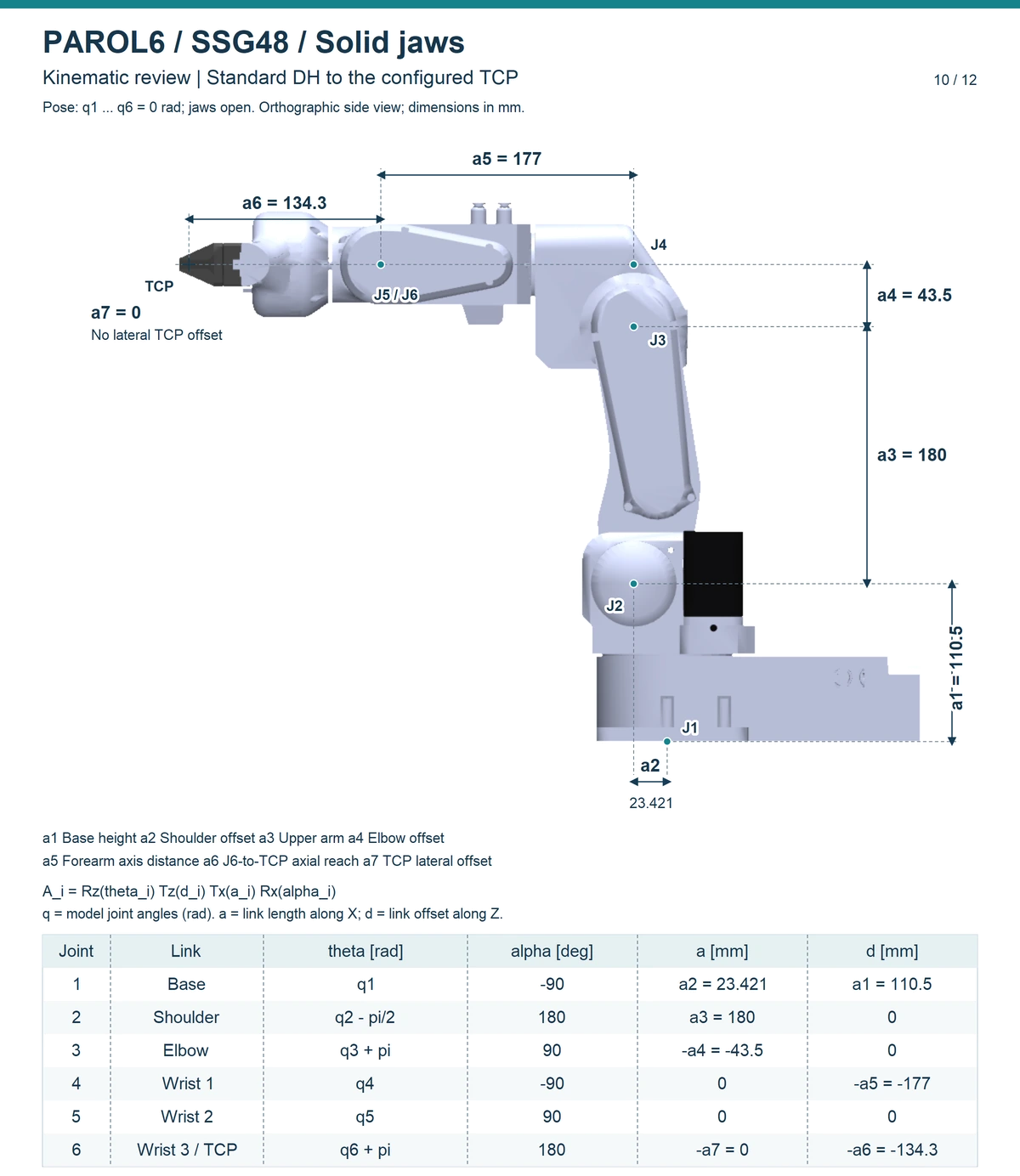
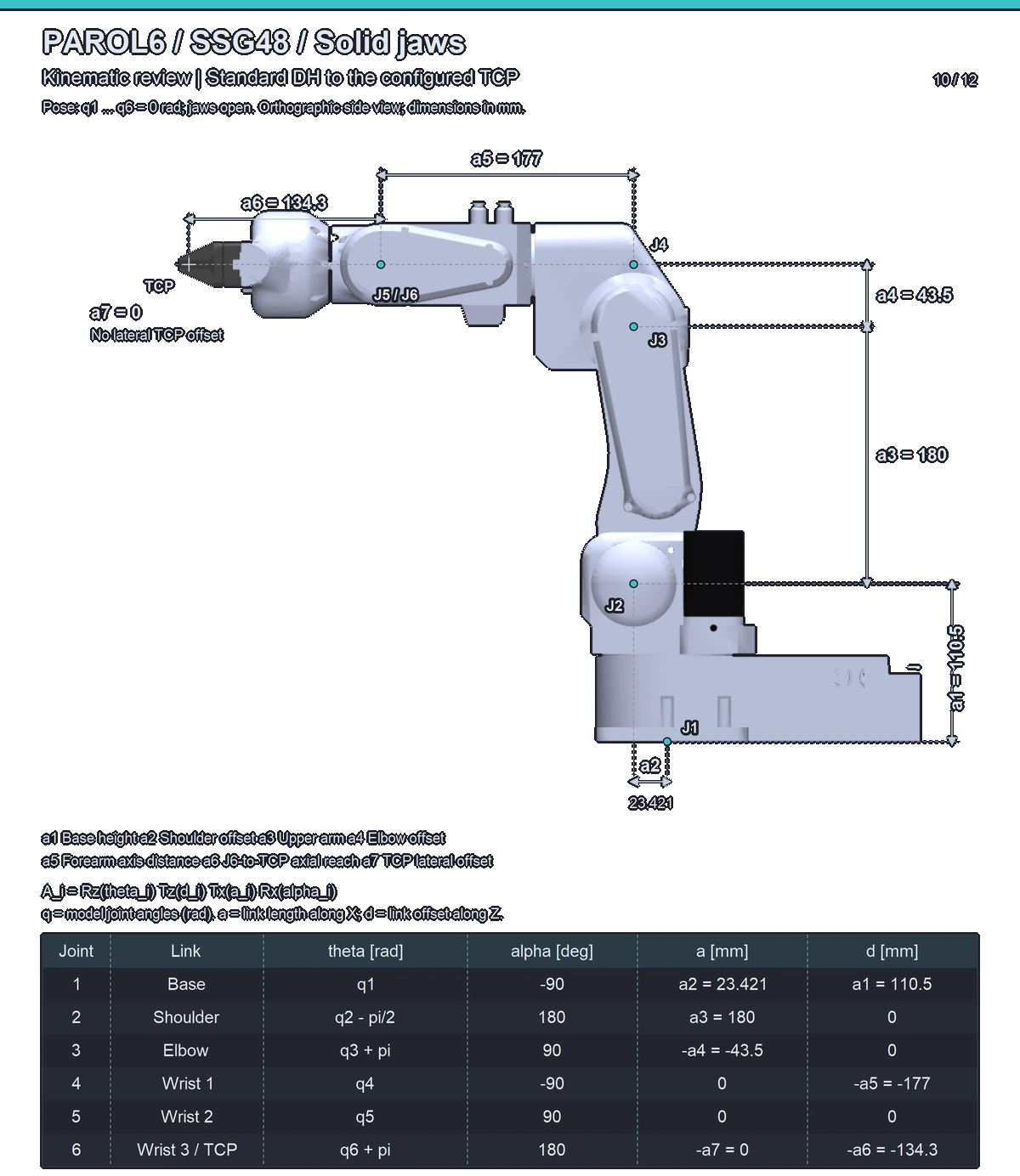
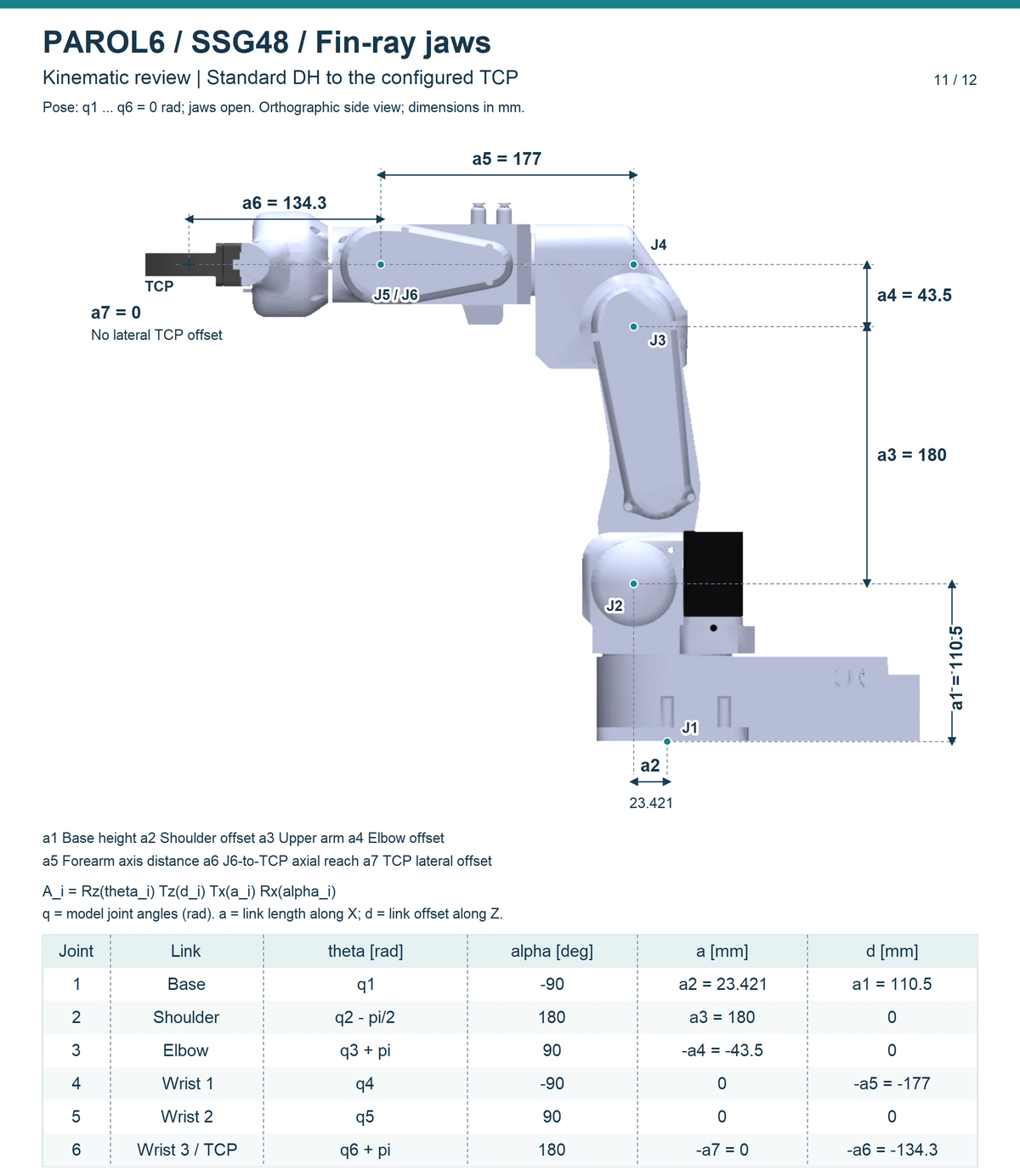
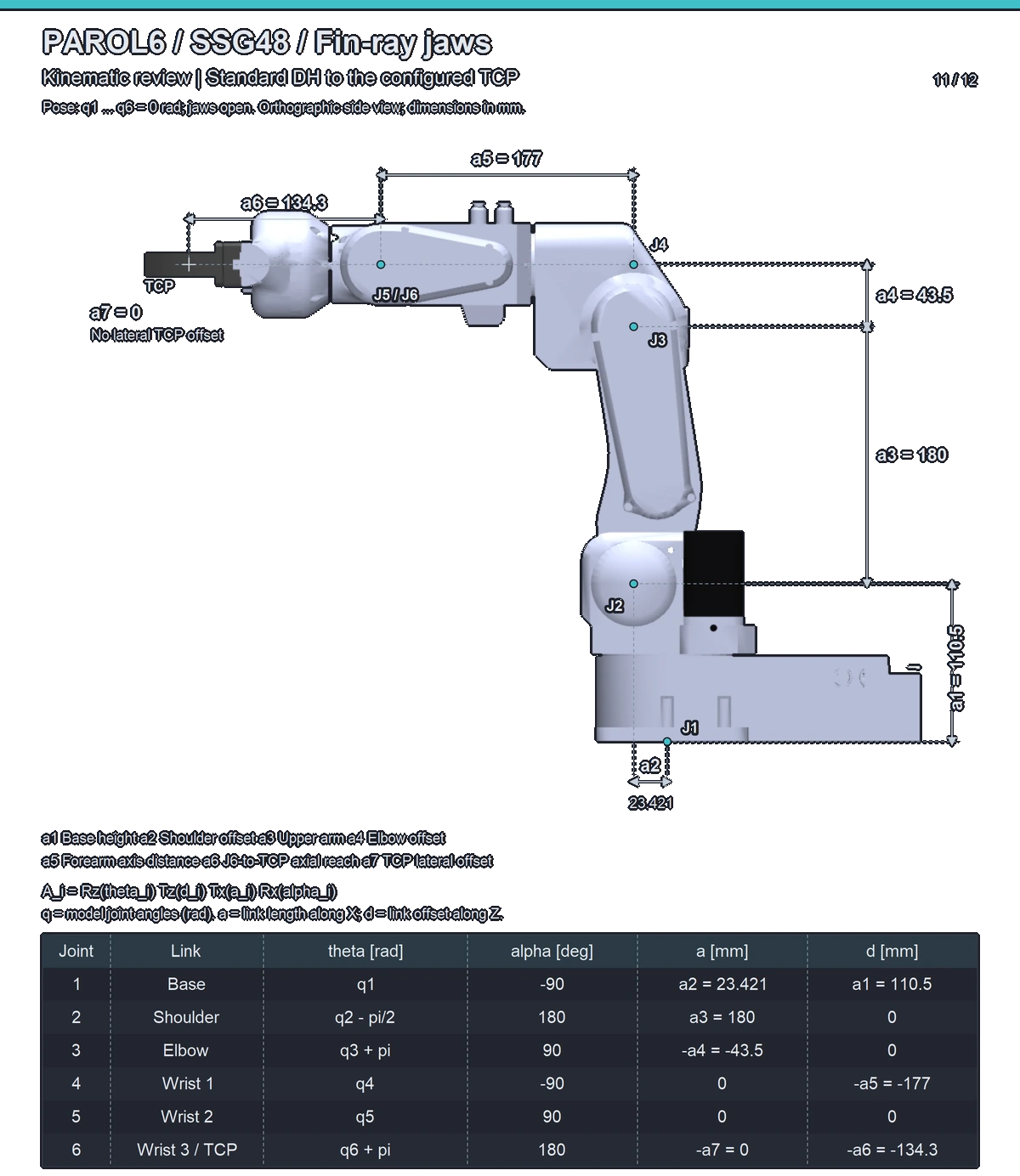
The tool centre point (TCP) is a6 = 134.3 mm from the joint 6 centre along the tool axis and a7 = 0 mm to the side. The TCP lies on the joint 6 axis, with no sideways offset, for both jaw variants. The sheet is the robot's model from robot_descriptions (version 2.15.1) with every joint at 0. Tell the software about the tool (Tools and the TCP); every tool is compared on Dimensions and kinematics.
The joint 5 homing offset
Joint 5 homes against the tool, and the SSG-48's coupler sits differently from the pneumatic gripper holder. Set
j5_homing_offset to 8035 in main.cpp of the control board firmware (the default, 8900, is for the
pneumatic gripper) and upload (Firmware). Check with the pin through the joint 5
witness marks after the first homing, and master if needed (Mastering).
Driving it
The gripper must be calibrated after every power-up: it opens fully and closes fully to find its end stops, and does not move before that. Clear any error first, then calibrate, then wait until the gripper reports itself calibrated before the first move: about 3 s.
The Gripper tab: after homing the robot press Clear gripper error, then Calibrate gripper, and
wait until the tab shows Calibration status is: 1. Then set position, speed and current with the sliders
and press Move GoTo. The feedback section shows the current, the position and the status
(The GUI). In RBTscript, after clearing the error in the tab:
Gripper_cal(), Delay(4), then Gripper(position, speed, current)
(RBTscript).
rbt.select_tool("SSG-48")                             # or add variant_key="pinch"
rbt.tool.calibrate()                                   # queued; the API counts it done after 2 s
rbt.delay(2)                                           # the rest of the calibration, with a margin
rbt.tool.set_position(0.8, speed=0.5, current=0.4)     # fractions of the ranges; 0.4 is 580 mA
rbt.tool.close(current=0.6)
rbt.tool.open()
rbt.tool.release()                                     # drop the grip, the jaws stay
rbt.tool.stop()                                        # immediate: halt where the jaws are
close() waits for the grip; a move on a gripper
that was never calibrated is refused when its turn comes. The API does not read the calibrated bit and has
no clear-error action at this version: clear an error in the commander's Gripper tab or with Motor GUI
(Tools and the TCP,
Tools).
Current and force
The current limit is the grip force, about 54 N per ampere: 300 mA is about 16 N, 1 A about 54 N. Start low and raise it for a firmer grip; a high current with a high speed slams the jaws into the part. The gripper manual's Force and speed has the curve and the heat limits.
The commander takes the current in milliamps, 100 to 1000 mA, so its strongest grip is about 54 N. The Python
API takes it as a fraction of 100 to 1300 mA: current=1.0 is 1.3 A, about 70 N.
Status
The robot passes the gripper's status byte through: calibrated, in motion, object detected (while closing, while
opening, or none), and its error bits. The commander's Gripper tab shows the calibrated and E-stop error bits, and
the whole status byte as a number (labelled Gripper object detection is). The Python API's tool.status() gives
the jaw position and the current; its engaged and part_detected do not follow the status byte's bits at this
version (Tool status). The gripper manual's errors
page says what each error needs: Errors and recovery.
Comments
Found a mistake on this page? Edit it on GitHub · Report it · Get help · This page as Markdown · llms.txt · The whole manual as PDF